Picture this: you are sitting on a tiny plastic stool, a cold Bia Hà Nội in one hand and a crispy, warm bánh mì in the other. The air is thick with the sweet aroma of charcoal-grilled pork and the rich scent of robusta coffee. Suddenly, a siren blares. The street erupts into a flurry of coordinated motion. Café owners rush to pull in low tables, tourists scramble back against the historic brick walls, and within seconds, a massive steel train thunders past—literally inches from your knees. This is the adrenaline-fueled reality of Hanoi’s famous Train Street.
While this narrow railway alley is globally famous as an Instagram sensation, most travelers don’t realize that it is also a fantastic destination for food lovers. If you know where to go, you can experience one of the most thrilling dining settings on the planet. This ultimate train street hanoi food guide covers everything you need to know: how to legally navigate the strict 2026 entry rules, what trackside delicacies you must order, the top cafes to watch the train from, and the legendary street food joints located just steps outside the barricades.
1. Bypassing the Barriers: The Legal Reality of Train Street in 2026
If you stroll up to the intersection of Trần Phú and Phùng Hưng expecting to walk freely onto the tracks, you will be met with a metal barrier, warning signs, and local security guards blowing whistles. Over the last few years, Vietnamese authorities have heavily restricted public access to Train Street due to severe safety concerns. Group tours are officially banned, and independent tourists are strictly prohibited from wandering the active railroad tracks alone.
However, the street is not fully closed. The local family-run cafes that line the tracks rely entirely on tourism to survive, resulting in a unique, regulated system. Today, there are two distinct sections of Train Street, and the only legal way to enter either is as a paying business guest of one of the cafes.
The Northern Section (Trần Phú / Phùng Hưng)
This is the most famous, highly photographed stretch of track located in the heart of Hanoi's Old Quarter. It is heavily guarded, but you can enter legally using the "Cafe Escort Method". When you arrive at the security barrier, do not try to sneak past or argue with the police. Instead, stand nearby and wait. Within a minute, a café owner or staff member will catch your eye, wave you over, and personally walk you past the guards as their guest. In exchange for entry, you are expected to order a drink or a plate of food at their establishment.
The Southern Section (Ngõ 224 Lê Duẩn)
Located about a 15-minute walk south of the main Old Quarter section, the Lê Duẩn segment is significantly less crowded, more rustic, and offers a highly authentic look into local residential life. While still subject to safety rules, it lacks the aggressive blockades of the northern end, allowing you to walk directly to a trackside cafe. If you want a calmer, more relaxed atmosphere to enjoy your train street hanoi food, this is the place to go.
2. Savoring the Tracks: What Can You Actually Eat and Drink on Train Street?
Because the trackside cafes are built inside tiny, narrow residential homes, they do not have massive commercial kitchens. However, the locals are masters of maximizing small spaces. The menus along Train Street offer an array of highly satisfying Vietnamese street foods and iconic beverages designed to be eaten quickly on low tables.
Must-Try Food on the Tracks
- Bánh Mì: The quintessential Vietnamese sandwich. Prepared with a warm, crackling French-style baguette, it is layered with savory liver pâté, mayonnaise, cold cuts, fresh cucumber slices, cilantro, and a dash of spicy chili sauce. Many cafes also offer vegetarian versions stuffed with pan-fried tofu.
- Nem Chua Rán (Fried Sour Pork Rolls): A legendary Hanoi youth snack. These are lightly fermented pork rolls coated in breadcrumbs and deep-fried until golden and crispy. Served hot with a sweet-and-spicy chili dipping sauce, they are the ultimate greasy comfort food.
- Nem Nướng (Grilled Pork Sausages): Highly seasoned minced pork skewers grilled over hot charcoal right on the edge of the track before the train arrives. They boast a beautiful smokey flavor and a perfect snap.
- Bánh Tráng Nướng (Vietnamese Pizza): A popular street snack consisting of a thin sheet of rice paper grilled over charcoal, topped with minced pork, quail eggs, green onions, dried shrimp, and a drizzle of sweet chili and mayonnaise.
- Mì Xào Bò (Stir-Fried Noodles with Beef): If you are looking for a heavier meal, many multi-story cafes can whip up a plate of instant noodles stir-fried with tender slices of beef and bok choy.
Signature Trackside Beverages
- Cà Phê Trứng (Egg Coffee): Hanoi's liquid gold. Invented in Hanoi in 1946 during a milk shortage, this drink features a rich, velvety custard made by whipping raw egg yolks with condensed milk and sugar, which is then floated on top of hot, dark robusta espresso. It tastes like a warm, caffeinated tiramisu.
- Cà Phê Cốt Dừa (Coconut Coffee): A refreshing, slushy-like blended mixture of sweet coconut cream, condensed milk, and ice, topped with a bold shot of Vietnamese espresso. It is the ultimate antidote to Hanoi’s humid summer heat.
- Bia Hà Nội (Hanoi Beer): Sip on a cold, light local lager while you chat with friends and wait for the tracks to clear. It pairs perfectly with fried pork rolls and grilled sausages.
3. Top 5 Trackside Cafes with Exceptional Food and Views
While nearly every café along the tracks offers a similar selection of drinks, their seating arrangements, views, and food quality vary. Here are five highly recommended spots where you can enjoy great train street hanoi food while waiting for the train:
1. Cat Coffee Restaurant 54 (Northern Section)
- Why Visit: This cozy, multi-story café is famous for housing a collection of adorable, friendly rescue cats. You can sit on the upper levels to get an incredible bird's-eye view of the train as it rounds the corner, or sit downstairs on the ground level with a cat on your lap.
- Food Highlight: Their crispy spring rolls and fried chicken wings are surprisingly good, making it a great spot for a savory lunch.
2. Railway Cafe Tuan (Northern Section)
- Why Visit: Widely recognized as the very first cafe to start the Train Street craze years ago, Tuan's is a piece of local history. The owner is exceptionally welcoming, speaks great English, and is highly vigilant about guest safety when the train arrives.
- Food Highlight: They serve one of the most balanced, authentic cups of egg coffee on the street, alongside delicious toasted banh mi.
3. Hanoi 1990s TrainStreet Coffee (Southern Section)
- Why Visit: Located in the quieter Lê Duẩn section, this cafe features gorgeous retro decor that transports you back to 20th-century Hanoi. The tables are well-spaced, the service is fast, and the atmosphere is significantly more authentic and less rushed than the northern section.
- Food Highlight: Their fresh seasonal fruit juices and simple plates of stir-fried noodles are highly rated.
4. Little Forest Cafe (Southern Section)
- Why Visit: True to its name, this cafe is adorned with beautiful potted green plants and boasts comfortable wooden high chairs (a rarity on Train Street, where low plastic stools are the norm). It offers a scenic, peaceful environment to unwind before the adrenaline rush.
- Food Highlight: Excellent coconut coffee and a fantastic selection of light sweet pastries that pair beautifully with hot drip coffee.
5. MER Café (Northern Section)
- Why Visit: Featuring a beautiful aesthetic with dangling paper lanterns and rustic wooden details, MER Café is a photographer’s dream. It has fantastic second-floor balcony seating, which offers a safer and more expansive view of the train passing below.
- Food Highlight: Their traditional iced milk coffee (Cà Phê Sữa Đá) is strong and authentic, served alongside classic roasted sunflower seeds to snack on.
4. The Ultimate Foodie Trail Just Steps Outside the Tracks
Because space on Train Street is highly constrained, the trackside cafes mostly focus on quick bites, snacks, and drinks. If you are looking for a massive, multi-course feast, the best strategy is to watch the train with a coffee or light snack, and then walk 2 to 5 minutes to the bustling streets that run parallel to the tracks.
The neighborhood directly surrounding Train Street—particularly Phùng Hưng Street—is a legendary street food haven. Here is where you should eat before or after your train adventure:
Phở Bò (Beef Noodle Soup) at Phố Cổ
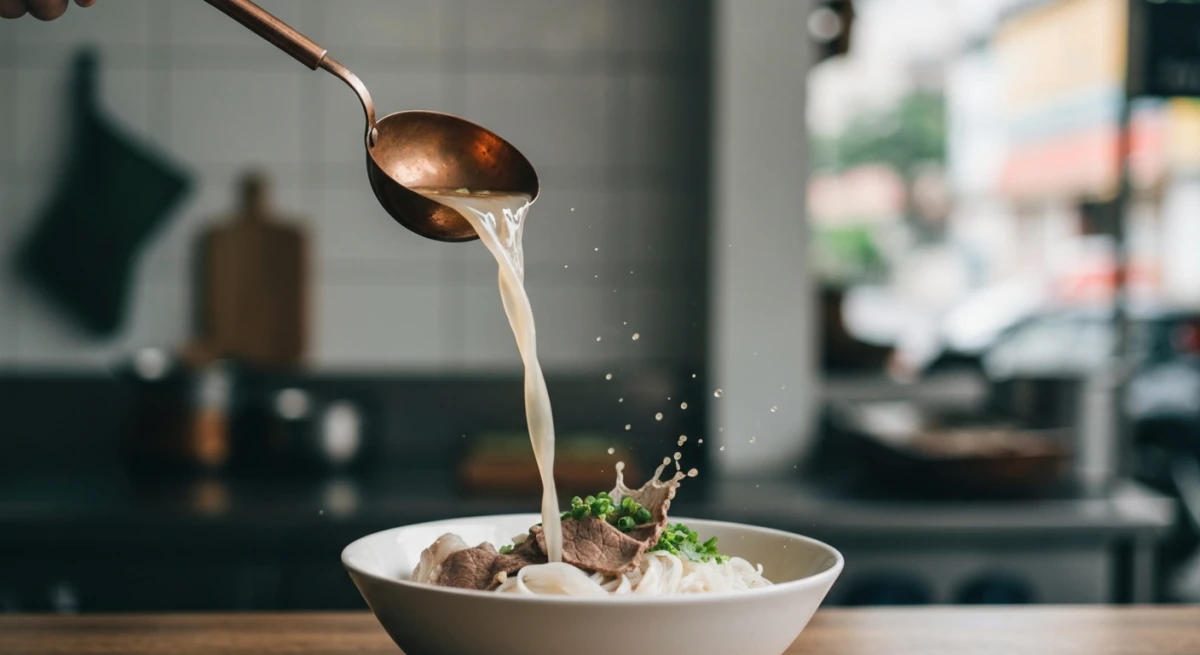
Hanoi is the birthplace of northern-style pho, which features a clearer, more delicate, and intensely savory bone broth compared to its sweeter southern counterpart. Just a 5-minute walk from the Trần Phú tracks, you will find legendary local stalls like Phở Gia Truyền Bát Đàn (49 Bát Đàn). Pull up a sidewalk stool and order a bowl of Phở Tái Nạm (half-done beef and beef flank) topped with a mountain of fresh green onions. Squeeze in some fresh lime, add a dash of garlic vinegar, and dip some Quẩy (fried dough sticks) into the steaming broth.
Cơm Tấm (Broken Rice) at Cơm Tấm Sài Gòn (57 Phùng Hưng)
While broken rice is traditionally a southern Vietnamese staple, Cơm Tấm Sài Gòn on Phùng Hưng Street serves up one of the best plates in the capital. The star of the dish is a massive, honey-marinated pork chop grilled over open charcoal until caramelized and juicy. It is served over fragrant, warm broken rice, accompanied by shredded pork skin, a rich steamed egg meatloaf, sweet-and-sour pickled vegetables, and a bowl of scallion oil-flecked fish sauce. It is a hearty, deeply satisfying lunch that costs less than $3 USD.
Bún Chả (Charcoal-Grilled Pork with Vermicelli)
No trip to Hanoi is complete without Bún Chả—the dish made globally famous by Barack Obama and Anthony Bourdain. Just steps from the Phùng Hưng murals, you will smell the smoke of pork belly and minced pork patties grilling over red-hot charcoal on the sidewalk. The grilled meat is submerged in a warm, sweet-tangy dipping sauce made of fish sauce, vinegar, sugar, and slices of green papaya. You eat it by dipping cold, slippery vermicelli noodles and piles of fresh herbs (mint, perilla, coriander) directly into the broth. Order a side of Nem Cua Bể (crispy fried crab spring rolls) to complete the meal.
Bánh Cuốn (Steamed Rice Rolls) at Bánh Cuốn Gia Truyền Thanh Vân
For a lighter, delicate meal, walk over to Bánh Cuốn Gia Truyền Thanh Vân (12–14 Hàng Gà), located just north of the train tracks. Here, you can watch the chefs expertly spread thin layers of fermented rice batter over a steam-heated fabric screen. Once cooked, the paper-thin sheet is rolled with minced pork and wood-ear mushrooms, topped with crispy fried shallots, and served with a warm dipping sauce. You can even customize your order by adding Chả Quế (cinnamon pork paste) or a poached egg.
5. Timing Your Feast: The Ultimate 2026 Train Street Timetable
To successfully combine your meal or coffee with the spectacle of a passing train, timing is everything. Trains only pass through several times a day, and the schedule is subject to sudden delays or unannounced extra runs.
Always arrive at least 30 to 45 minutes before the scheduled train times. This gives you enough time to meet a café owner, get escorted past the security guards, find a good seat, and order your train street hanoi food and drinks before the tracks are closed to pedestrians.
Below is the updated 2026 train schedule:
Northern Section Schedule (Trần Phú / Phùng Hưng)
- Monday to Friday: 8:30 AM | 9:30 AM | 11:50 AM | 3:15 PM | 7:50 PM | 9:15 PM | 9:30 PM | 10:00 PM
- Saturday and Sunday: 6:00 AM | 7:15 AM | 9:30 AM | 11:50 AM | 3:30 PM | 5:30 PM | 7:30 PM | 7:50 PM | 9:15 PM | 9:30 PM | 10:00 PM
Pro Tip: The weekend daytime slots (especially the 9:30 AM and 3:30 PM runs) offer the absolute best natural lighting for capturing photos and videos of the train while you dine.
Southern Section Schedule (Lê Duẩn)
- Daily (Monday to Sunday): 6:10 AM | 11:40 AM | 3:30 PM | 6:00 PM | 7:10 PM | 7:50 PM | 9:00 PM
Note: This schedule is a reliable guideline, but it is always smart to double-check with your café owner when you arrive, as they receive real-time updates directly from the railway station.
6. Surviving the Adrenaline Rush: Crucial Safety Rules for Diners
When a train passes through Hanoi Train Street, it is not a slow, gentle trolley. It is a massive, heavy-duty diesel locomotive traveling at significant speed. The clearance between the train body and the café walls is often less than a foot. To ensure you enjoy your meal safely, you must strictly adhere to the local trackside etiquette:
- Listen to the Cafe Owners: The moment you hear a horn or a whistle, stand up immediately and do exactly what the café staff tell you to do. If they tell you to sit down on a low step, push against the wall, or stand completely still, do it. They are looking out for your life (and their business license).
- Keep Your Limbs and Gear Tucked In: Never extend your arms, legs, cameras, phones, or selfie sticks toward the tracks as the train approaches. The wind draft created by the train is incredibly powerful and can easily pull loose items—or you—into the path of the train.
- Secure Your Belongings: The massive vibrations of the train will rumble through the ground and shake the café tables. Make sure your coffee cups, beer bottles, and phones are placed securely away from the edges of the tables so they don't rattle off and shatter on the ground.
- No Stepping on the Tracks: Once the warning horn has sounded, do not step onto the steel rails for a "quick last-second selfie". The train cannot stop quickly, and security guards or café owners will loudly reprimand you.
Frequently Asked Questions (FAQ)
Is Hanoi Train Street still open in 2026?
Yes, but access is highly restricted. You cannot walk freely along the tracks, and independent pedestrians will be turned away by guards at the barriers. However, you can legally enter by letting a local café owner escort you inside to sit at their establishment.
Do I need to pay an entry fee or buy a ticket?
No, there is no official entrance fee or ticket required to visit Train Street. However, because you must be escorted in by a café owner, it is mandatory that you purchase a drink or food at their establishment. Drinks generally cost between 30,000 to 65,000 VND ($1.20 - $2.70 USD).
Can I find vegetarian or vegan food on Train Street?
Yes! Many of the trackside cafes serve vegetarian banh mi stuffed with pan-fried tofu, cucumber, cilantro, and chili sauce. You can also find vegan spring rolls and classic local fruits. Always communicate your dietary needs clearly to the staff before ordering.
What is the best time of day to visit Train Street?
For the best daylight photos and a lively atmosphere, the weekend afternoon runs (3:30 PM and 5:30 PM) are spectacular. If you prefer a quieter, highly romantic vibe, visit during one of the evening runs (after 7:00 PM) when the entire street is lit up by gorgeous, colorful Vietnamese lanterns.
Conclusion
Visiting Hanoi’s Train Street is far more than just a quick photo opportunity; it is a profound, multi-sensory journey into the heart of Vietnamese urban life. Sitting trackside, inhaling the rich aroma of robusta beans, eating a perfectly crispy banh mi, and feeling the ground shake as the Reunification Express passes inches away is an experience you will remember for the rest of your life.
By following the "Cafe Escort Method," respecting the local safety rules, and exploring the incredible street food stalls on Phùng Hưng Street just outside the barriers, you will unlock the absolute best of what this historic neighborhood has to offer. Come hungry, stay safe, and enjoy the rush!