Introduction: Why Saigon is Vietnam's Undisputed Street Food Capital
To truly understand Ho Chi Minh City—still affectionately called Saigon by locals—you must experience it through your taste buds. The frantic hum of millions of motorbikes, the low-slung plastic stools lining every pavement, and the smoky aroma of charcoal-grilled pork are the lifeblood of this southern metropolis. Eating local food in ho chi minh city is not merely a daily routine; it is a sensory adventure, a social ritual, and a profound cultural experience.
Unlike the more conservative culinary landscape of Hanoi, Saigon’s food scene is a bold, sweet, and herb-rich tapestry. It reflects the city's history as a melting pot where diverse cultures have converged. Here, traditional Vietnamese flavors seamlessly blend with culinary influences from the Khmer Empire, Chinese merchants, and French colonists. Whether you are seeking a hearty bowl of breakfast soup, a quick street-side snack, or a late-night feast with friends, Saigon delivers around the clock.
This ultimate guide will take you beyond the superficial tourist trail. We will explore the iconic dishes that define the city, demystify the complex regional differences, reveal the best-kept local secrets, and equip you with the practical etiquette needed to dine like a true Saigonese. Prepare to dive headfirst into the legendary world of local food in ho chi minh city.
The Big Three: Icons of Saigon’s Street Food Scene
If you only have a short time in the city, there are three absolute culinary keystones that you must try. These dishes are eaten daily by millions of locals, ranging from construction workers to high-flying office executives.
1. Cơm Tấm (Broken Rice)
Historically a humble peasant dish, Cơm Tấm is the quintessential culinary symbol of Saigon. The name literally translates to "broken rice," referring to the fractured, imperfect grains left over from the traditional milling process. Because these grains are smaller, they absorb moisture and seasoning differently, resulting in a soft, light texture that holds up beautifully against rich toppings.
A standard plate of Cơm Tấm Sườn Nướng is a masterclass in culinary balance. The star of the show is a thin, tender pork chop marinated in a mixture of lemongrass, garlic, shallots, honey, and fish sauce, then grilled over open coals until smoky and caramelised. This is accompanied by:
- Chả Trứng: A steamed egg meatloaf made with minced pork, wood-ear mushrooms, and glass noodles, topped with a bright yellow egg yolk glaze.
- Bì: Shredded pork skin tossed in toasted rice powder (thính), providing a uniquely chewy, nutty texture.
- Mỡ Hành: A generous drizzle of scallion oil that adds richness.
- Đồ Chua: Sweet and sour pickled daikon and carrots to cut through the fat.
- Nước Mắm Ngọt: A sweet, garlic-and-chili-infused fish sauce drizzled liberally over the entire plate.
Where to eat like a local:
- Cơm Tấm Ba Ghiền (84 Đặng Văn Ngữ, Phú Nhuận District): A legendary institution that has earned a Michelin Bib Gourmand. They serve massive, thick-cut pork chops that are incredibly juicy.
- Cơm Tấm Mực (138 Nguyễn Văn Cừ, District 1): Known for its high-quality ingredients and a clean, nostalgic atmosphere that respects the street-food roots.
2. Southern-Style Phở (Phở Sài Gòn)
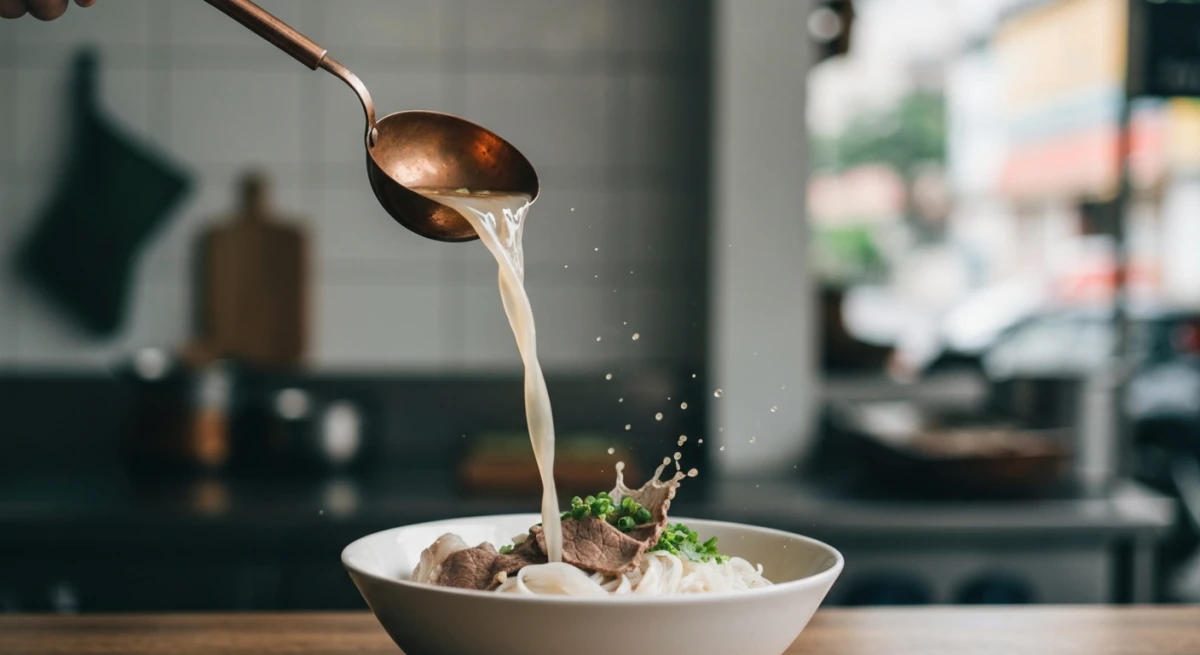
While Phở originated in the northern provinces of Vietnam, Saigon has fully adapted the noodle soup to suit its sweet-and-savory Southern palate. Understanding the difference between Northern and Southern Phở is a badge of honor for any foodie.
Northern Phở is minimalist and delicate, emphasizing a clear, savory broth, flat noodles, and simple garnishes of green onions. In contrast, Southern Phở is a riot of flavors, colors, and textures:
- The Broth: Sweeter and richer, simmered with beef bones, charred ginger, star anise, cinnamon, and cloves for up to 20 hours. It is also cloudier and heavier on the palate.
- The Meat: Aside from raw beef (tái) and brisket (nạm), Southern Phở commonly features bouncy beef meatballs (bò viên), tendon (gân), and tripe (sách).
- The Accompaniments: A massive basket of fresh herbs is placed on your table. It typically includes Thai basil (húng quế), culantro/sawtooth herb (ngò gai), rice paddy herb (ngò ôm), and fresh bean sprouts.
- The Sauces: Diners are expected to customize their bowl using hoisin sauce (tương đen) and chili sauce (tương ớt), either squirted directly into the broth or used as a dipping sauce for the meat.
Where to eat like a local:
- Phở Lệ (415 Nguyễn Trãi, District 5): A beloved Chinese-Vietnamese neighborhood spot famous for its incredibly rich, sweet broth and homemade beef balls.
- Phở Hòa Pasteur (260C Pasteur, District 3): One of the oldest and most famous Phở shops in Saigon, serving classic Southern-style bowls with generous portions of herbs.
3. Bánh Mì (The Ultimate Fusion Sandwich)
Bánh Mì represents the peak of French-Vietnamese culinary fusion. The French introduced the baguette, pâté, and mayonnaise, which the Vietnamese ingeniously lightened with rice flour to create an airy, ultra-crispy crust, and stuffed with local ingredients like coriander, chili, pickled vegetables, and Vietnamese ham (chả lụa).
While you can grab a classic cold-cut Bánh Mì from almost any street corner, Saigon offers several unique variations:
- Bánh Mì Kẹp Thịt: The standard version, layered with rich pork liver pâté, creamy egg yolk mayonnaise, various cold cuts, cucumber slices, fresh cilantro, pickled carrots/daikon, and a splash of savory maggi seasoning.
- Bánh Mì Chảo: A breakfast variation where ingredients like fried eggs, sausage, meatballs, and pâté are served sizzling in a small metal pan, accompanied by a hot, crusty baguette for dipping.
- Bánh Mì Khô: A dry variation or specialty versions featuring grilled beef or caramelized pork belly.
Where to eat like a local:
- Bánh Mì Huỳnh Hoa (26 Lê Thị Riêng, District 1): Known as the "heavyweight champion" of Saigon Bánh Mì. It is heavily packed with multiple layers of meat and pâté, easily big enough for two people.
- Bánh Mì Hòa Mã (53 Cao Thắng, District 3): A legendary breakfast spot that has been serving Bánh Mì Chảo (sizzling pan style) on tiny plastic stools down a quiet alley since 1958.
Beyond the Classics: Deep-Cut Southern Specialties
While most tourists stick to the standard trio of Phở, Bánh Mì, and Cơm Tấm, the true culinary soul of Saigon is found in its deep-cut southern specialties and fusion dishes. These are the meals that locals actively seek out when they want to eat well.
Hủ Tiếu Nam Vang (Phnom Penh Noodle Soup)
No dish better encapsulates the multicultural history of southern Vietnam than Hủ Tiếu Nam Vang. "Nam Vang" is the Vietnamese name for Phnom Penh, the capital of Cambodia. The dish was originally brought to Saigon by Teochew Chinese merchants migrating from Cambodia, creating a truly unique Cambodian-Chinese-Vietnamese hybrid.
The base of Hủ Tiếu Nam Vang is a clear, intensely sweet broth made from pork bones, dried squid, and dried shrimp. It is served with thin, translucent, chewy tapioca noodles (hủ tiếu). The toppings are incredibly diverse and hearty, usually including:
- Minced pork (which clouds the broth pleasantly)
- Slices of lean pork and pork liver
- Whole boiled shrimp
- Quail eggs
- Crispy fried shallots and garlic
- Fresh Chinese celery, garlic chives, and chrysanthemum greens
The dish can be ordered in two ways:
- Nước (With Soup): The hot broth is poured directly over the noodles and toppings.
- Khô (Dry): The noodles are tossed in a rich, sweet, and savory soy-and-oyster sauce mixture in a bowl, with the toppings placed on top. The piping hot broth is served on the side in a small bowl, allowing you to alternate between chewy noodles and sips of comforting soup.
Where to eat like a local:
- Hủ Tiếu Nam Vang Nhân Quán (122D Đường Cách Mạng Tháng Tám, District 3): A legendary, multi-generational spot known for its incredibly robust "dry" version.
- Hồng Phát (389-391 Nguyễn Trãi, District 1): A Michelin-recommended restaurant celebrating Khmer-Chinese roots, serving a refined, clean version of this complex soup.
Bò Lá Lốt (Beef Wrapped in Wild Betel Leaves)
If you want a communal, highly interactive dining experience, look no further than Bò Lá Lốt. Minced beef is seasoned with garlic, lemongrass, shallots, and five-spice, wrapped in wild betel leaves (lá lốt) to look like green cigars, and grilled over charcoal.
As the betel leaves heat up, they release an incredibly fragrant, herbal, slightly medicinal aroma that infuses the beef with smoky complexity. To eat Bò Lá Lốt, you assemble your own fresh rolls:
- Take a sheet of dry Vietnamese rice paper (bánh tráng).
- Lay down a bed of fresh herbs, lettuce, cucumber, green banana, and star fruit slices.
- Add a bundle of cold rice vermicelli noodles (bún).
- Place one or two grilled beef rolls on top.
- Roll it up tightly and dip it into Mắm Nêm, a pungent, fermented anchovy sauce mixed with crushed pineapple, chili, garlic, and lime juice. The sweet-sour-salty kick of the sauce cuts through the rich, smoky beef perfectly.
Where to eat like a local:
- Cô Liêng (321 Võ Văn Tần, District 3): A highly acclaimed spot (mentioned in the Michelin Guide) that grills their beef rolls to smoky perfection and serves them with exceptionally fresh herbs and high-quality Mắm Nêm.
- Hoàng Yến (143 Cô Giang, District 1): A popular, affordable local hangout in the historic Cô Giang food district.
Phá Lấu (Five-Spice Offal Stew)
For the culinarily adventurous, Phá Lấu is a beloved, highly addictive street snack. Originating from Chaozhou Chinese immigrants, this dish was born out of resourcefulness, utilizing leftover beef or pork offal (including stomach, tripe, intestines, and spleen) to minimize food waste.
The offal is thoroughly cleaned, marinated in five-spice powder, and slow-braised in a rich, creamy, and sweet broth made with coconut milk and annatto oil, giving it a vibrant orange hue. The result is surprisingly tender meat with a pleasant chew, devoid of any gaminess, swimming in a comforting, spiced broth. It is typically served hot with a crispy baguette (bánh mì) or instant noodles (mì gói), along with a sweet and sour tamarind dipping sauce.
Where to eat like a local:
- Phá Lấu Cô Nga (243/37A Tôn Đản, District 4): District 4 is widely considered the offal capital of Saigon, and Cô Nga is a legendary spot serving clean, creamy, and highly satisfying bowls of Phá Lấu.
- Phá Lấu Dì Nũi (243/30 Tôn Đản, District 4): Located just down the street from Cô Nga, this family-owned stall has been drawing massive crowds for nearly 40 years.
The Art of Saigon Street Dining: Etiquette and Practical Tips
Eating local food in ho chi minh city is as much about the environment and social culture as it is about the food itself. To fully enjoy your street food journey, it helps to understand the unwritten rules of Saigon's sidewalk dining scene.
1. Embrace the Plastic Stool Culture
In Saigon, the best food is rarely found inside air-conditioned dining rooms. Instead, it is served on the sidewalk, where you will sit on tiny plastic stools that are barely a foot off the ground. Do not let the rustic setup fool you; these street vendors are highly specialized specialists who have often spent decades perfecting a single, family recipe. Embrace the humidity, the proximity to the street, and the absolute lack of pretense.
2. Navigate the Table Condiments Like a Pro
When you sit down at a local street food stall, you will notice an array of jars and bowls on the table. Knowing how to use them is key to unlocking the true potential of your dish:
- Calamansi (Quất): Small, green citrus fruits. Squeeze these into noodle soups or dipping sauces for a bright, floral acidity that is smoother than lime.
- Chili Paste (Ớt Sa Tế): A spicy, smoky chili oil cooked with lemongrass and garlic. Add a small spoonful to your broth for deep heat.
- Garlic Vinegar (Dấm Tỏi): Slices of garlic pickled in vinegar, commonly added to Northern-style soups to brighten the broth.
- Fresh Chilies: Thinly sliced bird's eye chilies. Use with caution—they are incredibly hot!
3. Street Food Safety: Eat Smart
Saigon's street food is generally very safe, but a few basic precautions will keep your stomach happy:
- Look for High Turnover: Choose stalls that are packed with local families and young people. High turnover means the ingredients are exceptionally fresh and do not sit around in the heat.
- Watch the Ice: It is a common myth that you should avoid ice (đá) in Vietnam. Today, almost all commercial ice in Saigon is produced in clean, state-regulated factories in cylindrical tube shapes. If the ice has a hole through the center, it is safe to consume.
- Wipe Your Utensils: It is standard local practice to grab a tissue from the table dispenser and wipe down your chopsticks and spoon before eating.
4. Consider a Scooter Food Tour
Saigon is a massive, sprawling metropolis divided into 16 districts and several boutique cities. Navigating the chaotic traffic on your own can be highly intimidating. If you want to get truly off the beaten path into local residential neighborhoods like District 4, District 10, or Bình Thạnh, booking a guided scooter food tour is highly recommended. Local student guides will zip you through narrow alleys to hidden gems you would never find on Google Maps, sharing the rich history behind each bite.
Frequently Asked Questions
What is the most famous food in Ho Chi Minh City?
While Phở and Bánh Mì are famous worldwide, the most iconic local dish in Ho Chi Minh City is Cơm Tấm (Broken Rice). It is widely considered the ultimate culinary representative of Saigon’s street culture and is eaten for breakfast, lunch, dinner, and late-night snacks.
Is street food safe to eat in Saigon?
Yes, street food in Saigon is remarkably safe, provided you follow simple local guidelines. Eat at busy stalls with high turnover, drink bottled water or beverages with factory-made tube ice, and wipe your utensils before dining.
How much does a typical local meal cost in Ho Chi Minh City?
Local street food is incredibly budget-friendly. A hearty plate of Cơm Tấm or a bowl of Hủ Tiếu typically costs between 30,000 VND and 60,000 VND (approximately $1.20 to $2.50 USD). Even premium street food spots or Michelin-recommended stalls rarely exceed 100,000 VND ($4.00 USD) per portion.
Where can I find the best vegetarian local food in Ho Chi Minh City?
Vegetarianism is highly popular in Vietnam due to Buddhist traditions. Look for signs that say "Cơm Chay" (Vegetarian Food) or "Quán Chay". During the 1st and 15th days of the lunar month, almost every street food vendor offers vegetarian options. For a premium, highly refined vegetarian dining experience, check out Hum Vegetarian in District 3.
Conclusion: Savor Every Bite of Saigon
The vibrant landscape of local food in ho chi minh city is a testament to the resilience, creativity, and warm hospitality of its people. From the smoky charcoal grills of Cơm Tấm stalls in Phú Nhuận to the rich, five-spice aromas of Phá Lấu in District 4, the city offers a culinary narrative that is deeply satisfying and endlessly surprising. Do not be afraid to step out of your comfort zone, pull up a plastic stool, and dine alongside the locals. The true magic of Saigon is found one bowl, one bite, and one alleyway at a time.