Introduction: The Sensory Symphony of Hanoi's Historic Heart
Dawn breaks over Hanoi's Old Quarter like a culinary alarm clock. Steam rises from countless street corners, vendors wheel their cart-kitchens into positions they have held for decades, and the air fills with the rich aroma of star anise, roasted ginger, and charcoal-grilled pork. If you want to truly understand Vietnam's capital, you must step off the pavement and onto the pavement. The best street food in hanoi old quarter is not hidden away in expensive, air-conditioned restaurants—it is served in the open air, on tiny, colorful plastic stools lining busy sidewalks, where motorbikes buzz by just inches from your bowl.
For first-time visitors, the sheer chaos of the Old Quarter's food scene can feel overwhelming. With centuries-old streets dedicated to everything from silver and silk to bamboo and paper, finding authentic local stalls amidst tourist-heavy establishments requires a bit of insider knowledge. This comprehensive guide is designed to take you beyond the superficial lists and deep into the culinary soul of Northern Vietnam. From Michelin-recommended street gems to hidden alleyway noodle soup masters, here is your ultimate guide to mastering the world-class street food in Hanoi Old Quarter.
1. Sidewalk Etiquette: How to Eat Like a Hanoi Local
To fully appreciate Hanoi's street food, it helps to understand how Northern Vietnamese cuisine differs from the rest of the country. While Southern food (in cities like Saigon) is known for its sweet profiles, generous use of coconut milk, and fiery heat, Northern cuisine is characterized by its subtlety, balance, and pure, savory flavors. Black pepper, fresh lime, vinegar-pickled garlic, and delicate local fish sauce are the main seasoning agents. The goal is to let the freshness of the primary ingredients shine through rather than masking them.
Eating on the street in Hanoi is also a highly social, democratic experience. On any given sidewalk, you will see blue-collar laborers, office executives in sharp suits, university students, and international travelers sitting shoulder-to-shoulder on tiny plastic stools. It is an informal, fast-paced environment where the barrier between the kitchen and the customer is completely non-existent.
To navigate this scene like a seasoned local, keep these key etiquette rules in mind:
- The Seating Protocol: Do not wait to be formally greeted or escorted to a table. If you see an empty stool, simply sit down. If the stall is busy, make eye contact with the vendor, hold up your fingers to show how many people are in your group, and they will quickly arrange a spot for you.
- The Utensil Wipe: Before you eat, it is standard practice to grab a tissue from the plastic box on your table and wipe down your chopsticks and spoon. For an extra layer of cleanliness, squeeze a wedge of fresh lime over your utensils—the citric acid acts as a natural disinfectant.
- Handling the Scrap: You will notice crumpled napkins, lime wedges, and herb stems on the floor beneath the tables. While this may look untidy to Western eyes, it is the norm here. If there isn't a small trash bin under your table, simply drop your waste on the floor; the staff sweeps the dining area clean throughout the day.
- Paying with Cash: Street food vendors operate almost exclusively on cash. Always carry small Vietnamese Dong (VND) denominations, such as 10,000, 20,000, and 50,000 notes. Trying to pay for a 35,000 VND ($1.40 USD) noodle soup with a 500,000 VND ($20.00 USD) note is highly discouraged as vendors rarely have that much change on hand.
2. Legendary Dishes of Hanoi’s Old Quarter (And Where to Try Them)
Phở (The Legendary Vietnamese Noodle Soup)
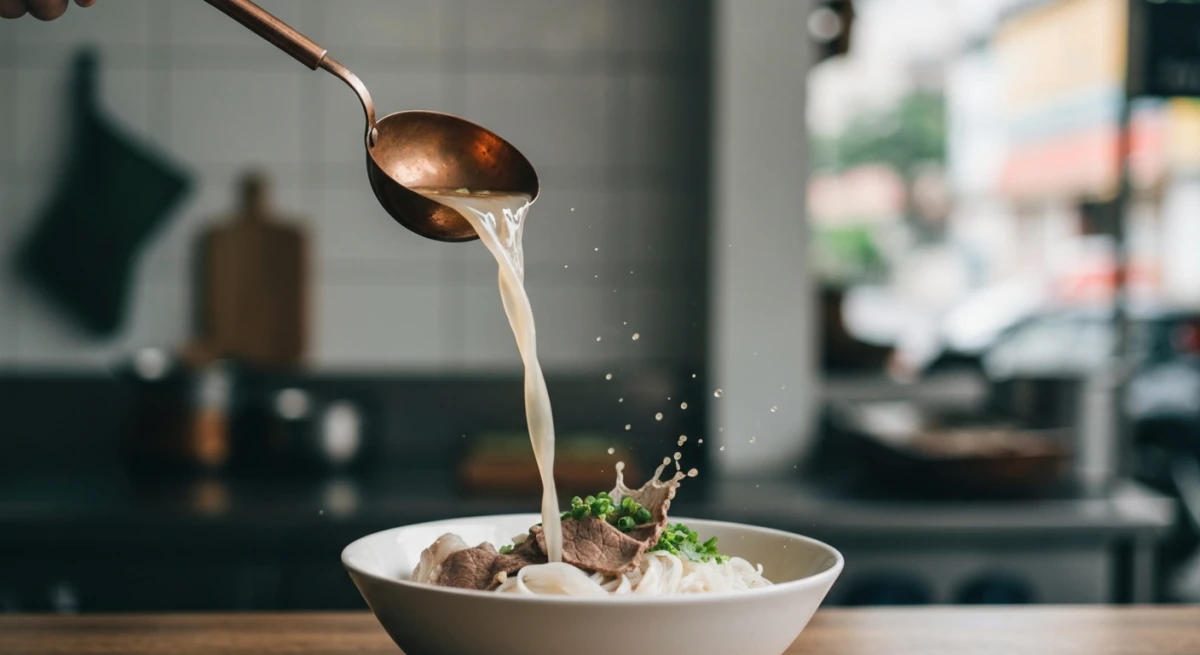
Phở is the undisputed national dish of Vietnam, and Hanoi is its spiritual birthplace. A classic Northern bowl of beef pho (Phở Bò) is a masterclass in culinary patience. The broth is the star of the show—a clear, deeply aromatic liquid made by simmering beef marrow bones, charred ginger, onions, star anise, black cardamom, cinnamon, and fish sauce for up to 24 hours. Unlike the Southern version, traditional Northern pho is never served with bean sprouts, basil, or hoisin sauce. Instead, it is garnished purely with a generous handful of fresh green onions and cilantro. To eat it like a local, squeeze a bit of fresh lime, add a few slices of bird's eye chili, splash some garlic vinegar (dấm tỏi) into the broth, and order a plate of quẩy (deep-fried dough sticks) to dip into the soup.
- Phở Gia Truyền Bát Đàn (49 Bát Đàn): This is one of the most famous, historic pho joints in the city. The queue here is legendary and operates on a traditional self-service system: you stand in line, order and pay at the counter, and carry your own piping-hot bowl to a low wooden table. The beef is sliced to order, and the broth has an incredibly deep, comforting bone-marrow flavor.
- Phở Sướng (Trung Yên Alley): Tucked inside a narrow, labyrinthine alleyway, this hidden gem serves a lighter, incredibly clean, and aromatic broth with exceptionally tender beef. It is a local favorite that avoids the massive tour groups.
- Phở 10 Lý Quốc Sư (10 Lý Quốc Sư): A Michelin-recommended spot that provides a slightly more modern, clean environment with an open kitchen. The quality of the beef here is remarkably consistent, and the broth is outstanding.
Bún Chả (Charcoal-Grilled Pork with Rice Noodles)
If pho rules the Hanoian morning, Bún Chả absolutely dominates the lunch hour. This iconic dish consists of charcoal-grilled fatty pork belly slices (chả miếng) and seasoned minced pork patties (chả viên) swimming in a warm, sweet-sour-salty dipping broth made of fish sauce, vinegar, sugar, and lime juice. The broth is garnished with crunchy pickled green papaya and kohlrabi. It is served with a plate of cold rice vermicelli noodles (bún) and a massive mountain of fresh local herbs, including perilla (kinh giới), Vietnamese balm (tía tô), and mint. To eat it, grab a small portion of noodles and herbs, submerge them in the warm dipping broth with a piece of pork, and slurp it all up together.
- Bún Chả Hàng Quạt (74 Hàng Quạt): Deep inside a dark, residential alleyway that looks like a dead-end, you will suddenly stumble upon a bustling courtyard filled with charcoal smoke and the mouthwatering smell of grilling pork. This is widely considered the best bún chả in the Old Quarter, famous for its sweet, caramelized pork patties.
- Bún Chả Ta (21 Nguyễn Hữu Huân): A highly accessible, Michelin-selected restaurant spread over multiple floors of a traditional shophouse. It features bamboo furniture and offers a clean dining environment with incredibly flavorful dipping broth and outstanding, crispy seafood spring rolls (nem rán).
Bánh Mì (The Minimalist Fusion Baguette)
While the bánh mì of Southern Vietnam is famous for being heavily loaded with a mountain of cold cuts, pickles, and multiple sauces, the traditional Hanoi style is far more minimalist. It focuses on the sheer quality of the bread—which must be incredibly light and airy with a razor-thin, crispy crust—and a thick, rich layer of homemade pork liver pâté. A classic Hanoi bánh mì features just a smear of pâté, a sprinkle of savory pork floss, a few slices of roasted pork char siu, fresh cucumber, coriander, and a simple drizzle of local chili sauce. This elegant balance ensures that the buttery richness of the pâté and the crunch of the bread are the stars.
- Bánh Mì Lân Ông (8 Lân Ông): Operating for decades, this legendary shop is famous for its decadent, buttery house-made liver pâté. The pâté is spread thickly onto hot, toasted baguettes, accompanied by crispy fried shallots, cucumber, and cilantro. It represents the absolute pinnacle of traditional Hanoian bánh mì.
- Bánh Mì Mama (54 Lý Quốc Sư): A tiny street-side cart located near St. Joseph’s Cathedral. Mama is beloved by both locals and travelers for her warm, grandmotherly hospitality and her perfectly balanced mixed bánh mì (bánh mì thập cẩm).
Bánh Cuốn (Silky Steamed Rice Rolls)
Bánh Cuốn is one of the most delicate and beautiful breakfast dishes in Northern Vietnam. It consists of paper-thin sheets of fermented rice batter steamed over a tightly stretched cloth on top of a boiling pot of water. The cook uses a thin bamboo stick to lift the translucent sheet, lays it flat, fills it with seasoned minced pork and wood ear mushrooms, and rolls it up. It is dusted with crispy fried shallots (hành phi) and served with fresh herbs and a bowl of warm, mild fish sauce dipping liquid. It is often accompanied by slices of chả lụa (Vietnamese pork sausage).
- Bánh Cuốn Gia Truyền Thanh Vân (14 Hàng Gà): A multi-generational family shop where you can watch the master cooks steam the rice sheets with incredible speed at the entrance. An insider tip: you can ask them to add a drop of cà cuống (essence of giant water bug) to your dipping sauce. It adds a highly unique, piney, pear-like aroma that is a traditional delicacy in Hanoi.
- Tuệ An / Bếp Tuệ An (Hanoi Old Quarter): A lovely family-run local spot that serves silky-smooth rice rolls alongside comforting bowls of pho bò, offering a truly authentic, unpretentious dining experience.
Bún Riêu Cua (Tangy Crab and Tomato Noodle Soup)
Bún Riêu Cua is a vibrant, deeply satisfying noodle soup that showcases the rustic flavors of the Red River Delta. The broth is crafted from freshwater crabs, which are crushed and strained to create a rich, paste-like crab mixture (riêu cua) that floats on top of the broth like soft clouds. This is combined with stewed tomatoes, fried tofu puffs, and rice vinegar for a tangy, sour kick.
- Bún Riêu Trang (23 Nguyễn Siêu): This is the absolute gold standard for bún riêu in the Old Quarter. You can customize your bowl with various toppings, including tender beef slices, snails (ốc), or giò sống (pork balls). The broth here is exceptionally balanced—perfectly tangy from the tomatoes and rich from the crab.
Cà Phê Trứng (Velvet Egg Coffee)
While egg coffee is a drink, it is so thick, sweet, and decadent that it functions as a dessert. It was invented in 1946 by Mr. Nguyen Van Giang during a severe milk shortage caused by the French war. Working as a bartender at the Sofitel Legend Metropole Hanoi, he whipped up egg yolks with condensed milk, sugar, and honey to create a rich, velvety foam, which he poured over hot, dark Robusta coffee.
- Café Giảng (39 Nguyễn Hữu Huân): The ultimate pilgrimage site for coffee lovers. Tucked down a narrow alleyway, this bustling café is the birthplace of egg coffee.
- Café Đinh (13 Đinh Tiên Hoàng): Run by Giang’s daughter, this café is located on the second floor of an ancient building near Hoan Kiem Lake. To find it, you must walk through a bag shop and climb a dark, rustic staircase. It has an artistic, old-school Hanoi atmosphere and offers a slightly stronger, less sweet egg coffee than Giảng.
- Loading T (8 Chân Cầm): Housed in a gorgeous, decaying French colonial villa, Loading T roasts its Arabica and Robusta beans with a touch of cinnamon, giving their egg coffee a uniquely aromatic, spiced undertone.
3. The Ultimate Self-Guided Street Food Walk
Exploring the maze of the Old Quarter can be overwhelming, so we have designed the ultimate, logical walking itinerary that covers breakfast, mid-morning coffee, lunch, afternoon snacks, and a late-night feast. Pack your appetite and put on comfortable walking shoes—this is a 3-kilometer culinary journey.
- 08:00 AM – Step 1: The Steaming Morning Start at Bánh Cuốn Thanh Vân Start your day at 14 Hàng Gà Street. Order a plate of classic pork and wood ear mushroom bánh cuốn, topped with crispy shallots. Sip the warm dipping sauce, and watch the busy motorbikes zoom past as Hanoi wakes up. (Estimated cost: 40,000 VND / $1.60 USD)
- 09:30 AM – Step 2: The Cinnamon-Infused Caffeine Kick at Loading T From Hàng Gà, head south toward Chân Cầm Street. Walk through the grand arched entrance of 8 Chân Cầm and climb the tiled staircase to Loading T. Order their famous hot egg coffee. The warm, cinnamon-infused brew is the perfect companion to a quiet morning of people-watching from the balcony. (Estimated cost: 45,000 VND / $1.80 USD)
- 12:00 PM – Step 3: The Smokey Alleyway Feast at Bún Chả Hàng Quạt Make your way east toward Hàng Quạt Street. Locate the narrow alley at number 74. Follow the smell of grilling pork and the smoke rising from the coals. Sit down on a blue plastic stool and order a portion of bún chả. Don't forget to ask for a side of nem rán (fried spring rolls). (Estimated cost: 50,000 VND / $2.00 USD)
- 03:00 PM – Step 4: The Sweet, Savory, and Crunchy Refreshment at Nộm Long Vi Dung Walk south toward the iconic Hoàn Kiếm Lake. On the corner of Đinh Tiên Hoàng and Cầu Gỗ, you will find Nộm Bò Khô Long Vĩ Dung. Grab a sidewalk table and order their signature dried beef salad (nộm thịt bò khô). The combination of shredded green papaya, beef jerky, roasted peanuts, and sweet-sour dressing is incredibly refreshing on a warm afternoon. (Estimated cost: 35,000 VND / $1.40 USD)
- 06:00 PM – Step 5: The Sunset Baguette at Bánh Mì Lân Ông Walk northwest back into the heart of the Old Quarter to 8 Lân Ông Street. Grab a fresh, hot-out-of-the-oven bánh mì with their legendary house-made pâté and crispy fried shallots. It's the perfect pre-dinner snack as the city lights begin to flicker on. (Estimated cost: 30,000 VND / $1.20 USD)
- 08:00 PM – Step 6: The Late-Night Simmer at Bún Riêu Trang Finish your epic food journey at 23 Nguyễn Siêu Street. Order a steaming bowl of bún riêu cua with beef and tofu. The sour, crab-infused broth is the ultimate comforting wrap-up to your culinary adventure. Afterwards, if you still have energy, walk over to the nearby Tạ Hiện Street (Beer Street) to enjoy a cold, fresh Bia Hơi (draught beer) on the sidewalk for just 10,000 VND ($0.40 USD) per glass.
4. Insider Secrets: Safety, Timing, and Spotting the Best Stalls
Eating street food in a developing country can sometimes trigger anxiety for international travelers. However, with a few simple, actionable rules, you can enjoy Hanoi's incredible culinary scene with complete peace of mind:
- The Single-Dish Rule: In Hanoi, culinary mastery is built on hyper-specialization. Avoid street restaurants that have a multi-page, multi-cuisine menu offering everything from spring rolls to fried rice and pad thai. These are tourist traps. Look instead for stalls that serve only one or two dishes—for instance, a stall that only does Phở Bò, or a vendor who only fries Bánh Gối (pillow cakes). When a family has spent decades cooking a single recipe, the quality is guaranteed to be world-class.
- Follow the Office Workers: The most reliable indicator of street food safety and quality is a long queue of local Vietnamese office workers during the breakfast (7:00 AM - 8:30 AM) or lunch (11:30 AM - 1:00 PM) rush. Locals have unlimited options and limited time; they will only frequent vendors who serve fresh, high-quality, and safe food at fair prices.
- Observe the Turnover: High customer turnover means that ingredients are constantly being replenished and never sit around at room temperature. Fresh meats are sliced and cooked instantly, and vegetables are washed and served rapidly.
- The Ice Myth: Many travelers worry about catching 'Hanoi belly' from the ice in their drinks. In the Old Quarter, almost all street food vendors purchase their ice commercially from local purified water ice factories. You can easily recognize safe ice: it consists of uniform, machine-cut tubes with a hole down the center. Avoid crushed ice from a large block, but feel free to enjoy the tubular ice.
- Eat at Local Peak Hours: Street food stalls operate on strict, local culinary rhythms. To ensure you get the absolute freshest food, eat when the locals eat. If you try to eat Bún Chả at 4:00 PM, you will likely get cold, leftover pork that has been sitting out. Stick to local breakfast, lunch, and dinner windows.
5. Frequently Asked Questions (FAQ)
How much does a typical street food meal cost in Hanoi's Old Quarter? Street food in Hanoi is incredibly affordable. A bowl of noodle soup (Phở or Bún Riêu) typically costs between 35,000 and 60,000 VND ($1.40 - $2.40 USD). A Bánh Mì ranges from 25,000 to 45,000 VND ($1.00 - $1.80 USD). An Egg Coffee costs around 30,000 to 50,000 VND ($1.20 - $2.00 USD). A full day of eating like a king will rarely cost more than $10 to $15 USD.
Is street food in Hanoi safe for foreigners? Yes, street food in Hanoi is generally very safe. Because of the sheer volume of customers and the daily morning markets, ingredients are sourced fresh every single day and consumed rapidly. Just remember to stick to high-turnover stalls, ensure your food is served hot, and use hand sanitizer before eating.
Do street food vendors accept credit cards? No. Street food stalls and small local restaurants in Hanoi operate almost exclusively on cash. Always keep small denominations of Vietnamese Dong (VND) with you, as vendors may not have change for larger 500,000 VND notes.
How do I order if I don't speak Vietnamese? Many popular street food stalls in the Old Quarter have simple signs displaying the dishes and prices. If there is no English menu, simply point at what other diners are eating, hold up your fingers to indicate the quantity, and smile. Vietnamese street vendors are incredibly welcoming and accustomed to communicating via simple gestures.
Should I tip street food vendors in Vietnam? Tipping is not customary or expected in Vietnam, especially at casual street food stalls. The price quoted is exactly what you should pay. However, leaving the small change or rounding up your bill is a kind gesture that is always appreciated.
Conclusion: Embracing the Chaos, One Stool at a Time
To truly experience Hanoi, you must let go of your notions of formal dining. Put aside the white tablecloths, step onto the bustling sidewalk, and claim your low plastic stool. Street food in the Old Quarter is more than just a meal—it is a daily ritual, a living history, and the beating heart of Vietnamese culture. By stepping out of your comfort zone, following the local crowds, and letting your senses guide you, you will discover why Hanoi is globally recognized as one of the greatest culinary capitals on Earth.