Introduction: The Sensory Symphony of Hanoi's Old Quarter
Step onto the pavements of Hanoi's historic Old Quarter and your senses are instantly bombarded. The high-pitched beep of motorbikes, the tangled webs of ancient telephone lines overhead, the colonial yellow facades peeling in the humid air—it is a beautiful chaos. But beneath the frenetic surface of these thirty-six historic guild streets lies the true heartbeat of the Vietnamese capital: its legendary culinary landscape. If you are searching for the ultimate street food old quarter hanoi experience, you are not just looking for a meal; you are seeking an invitation to sit on a low plastic stool, shoulder-to-shoulder with locals, and participate in a culinary tradition spanning generations.
For first-time visitors, navigating this gastronomic maze can feel intimidating. Every narrow alleyway seems to house a sizzling griddle, a steaming pot of aromatic broth, or a charcoal grill billowing sweet smoke into the air. Which spots are authentic institutions, and which are watered-down tourist traps? How do you order without speaking Vietnamese? And most importantly, how do you dive into this street food wonderland while keeping your stomach perfectly happy? This comprehensive guide is written to answer those exact questions, providing you with a highly curated, safety-conscious, and delicious roadmap to the best street food in Hanoi's Old Quarter.
Navigating the Sidewalk Culture: A Beginner's Survival Guide
Before you take your first bite, you need to understand the theater of Hanoi's streets. Eating here is a highly interactive, public affair. The sidewalks, locally known as "vỉa hè," are not merely thoroughfares; they are dining rooms, social clubs, and kitchens.
The Low Stool Philosophy
In the Old Quarter, luxury is measured by the depth of flavor, not the height of your chair. The iconic red and blue plastic stools that spill onto the curb serve a practical purpose: they are cheap, easily stackable when municipal police clear the sidewalks, and they keep you close to the ground, where the aromas are richest. Do not be shy about pulling up a stool. If a stall is crowded, simply point to an empty seat, catch the owner's eye, and raise a finger to indicate how many of you are dining.
The Cash Economy and Small Change Hacks
Cash is absolute king on the streets of Hanoi. Credit cards are virtually useless at open-air stalls. When you arrive in the city, break your large 500,000 VND (Vietnamese Dong) bills at convenience stores like Circle K or WinMart to secure smaller denominations.
- Keep a stash of 10,000, 20,000, and 50,000 VND notes in an easily accessible pocket.
- Handing a street vendor a 500,000 VND note for a 30,000 VND bowl of noodles is considered bad form, and they often will not have the change.
- Always pay at the end of your meal. Simply stand up, make eye contact with the vendor, and say "Bao nhiêu?" (How much?) or point to your table.
The Pedestrian Shuffle: How to Cross the Street
The fear of crossing the street prevents many travelers from fully exploring the Old Quarter's food scene. The secret to crossing the road in Hanoi is simple: walk at a slow, predictable, and steady pace. Do not make sudden stops, do not run, and do not look at your phone. The oncoming waves of motorbikes are calculating your trajectory; as long as you move consistently, they will smoothly flow around you like water around a stone.
The 8 Unmissable Dishes (and Exactly Where to Find Them)
The culinary identity of Northern Vietnam is characterized by balance, subtlety, and deep savory profiles. Unlike the sweeter, chili-heavy dishes of Southern Vietnam, Hanoian street food relies on the delicate interplay of fresh herbs, black pepper, lime, and meticulously simmered bone broths. Here are the eight non-negotiable dishes you must try in the Old Quarter, along with the precise locations that do them justice.
| Dish Name | Local Vietnamese Name | Key Ingredients | Typical Price Range (VND) | Recommended Spot & Address |
|---|---|---|---|---|
| Beef Noodle Soup | Phở Bò | Beef bone broth, rice noodles, ginger, herbs | 55,000 - 75,000 VND | Phở Gia Truyền Bát Đàn, 49 Bát Đàn |
| Grilled Pork Noodles | Bún Chả | Grilled pork patties, rice vermicelli, sweet-tangy broth | 35,000 - 50,000 VND | Bún Chả Hàng Quạt, Alley 74 Hàng Quạt |
| Steamed Rice Rolls | Bánh Cuốn | Steamed rice sheets, wood-ear mushroom, pork, shallots | 35,000 - 60,000 VND | Bánh Cuốn Gia Truyền Thanh Vân, 12-14 Hàng Gà |
| Crab Tomato Soup | Bún Riêu Cua | Freshwater crab paste, tofu, tomato broth, rice noodles | 35,000 - 50,000 VND | Bún Riêu Cua Hàng Bạc, 11 Hàng Bạc |
| Turmeric Fish | Chả Cá Lăng | Turmeric-marinated fish, dill, scallions, peanuts | 130,000 - 150,000 VND | Chả Cá Thăng Long, 6B Đường Thành |
| Traditional Baguette | Bánh Mì | Crispy baguette, pâté, fresh herbs, pork belly/chicken | 25,000 - 45,000 VND | Bánh Mì Mama, 54 Lý Quốc Sư |
| Egg Coffee | Cà Phê Trứng | Robusta coffee, whipped egg yolk, condensed milk | 30,000 - 45,000 VND | Cà Phê Đinh, 13 Đinh Tiên Hoàng (2nd Floor) |
| Sweet Sticky Rice Soup | Xôi Chè | Sweet sticky rice, mung bean paste, jasmine syrup | 20,000 - 30,000 VND | Xôi Chè Bà Thìn, 95 Hàng Bồ |
1. Phở Bò (Beef Rice Noodle Soup) at Phở Gia Truyền Bát Đàn
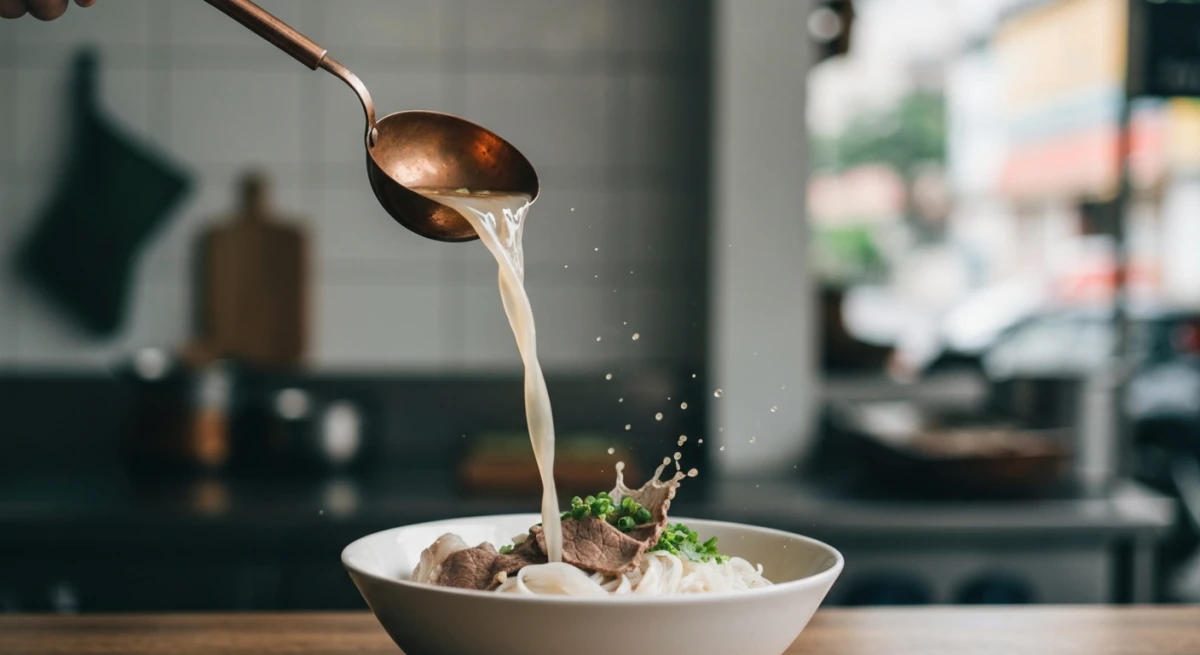
You cannot write a guide about street food old quarter hanoi without starting with Pho. However, true Northern Pho is an art form distinct from its Southern counterpart. There are no sweet hoisin sauces or piles of bean sprouts here; instead, the focus is entirely on a crystal-clear, intensely fragrant beef bone broth simmered for over 12 hours with charred ginger, onions, cinnamon, and star anise.
- The Spot: Phở Gia Truyền Bát Đàn (49 Bát Đàn Street). This legendary establishment has been serving bowls since the 1940s. The sign reads "Gia Truyền," which literally translates to "passed down through generations"—a marker of ultimate culinary pedigree.
- The Experience: You will join a queue that often spills onto the street. You pay the master carver at the front, choose your meat—Phở Tái (rare beef slices), Phở Chín (well-done brisket), or Phở Nạm (flank)—grab your own steaming bowl, and find a seat at the communal wooden tables.
- Local Tip: Order a side of Quẩy (deep-fried dough sticks). Dip these crispy, airy batons into your broth to soak up the spiced beef essence.
2. Bún Chả (Charcoal-Grilled Pork Noodles) at Bún Chả Hàng Quạt
While Bún Chả Hương Liên gained global fame after President Obama and Anthony Bourdain dined there, locals in the Old Quarter know that the most transcendental Bún Chả is served in a hidden alleyway off Hàng Quạt.
- The Spot: Bún Chả Hàng Quạt (Alley 74 Hàng Quạt Street).
- The Experience: Follow the rich, sweet smell of charcoal-grilled pork deep into a narrow, one-meter-wide alleyway. Here, you will sit on tiny blue stools right next to the smoking grill. The dish consists of smoky, caramelized pork patties (chả viên) and tender pork belly slices (chả miếng) submerged in a warm bowl of fish-sauce-based broth sweetened with sugar and tangy vinegar, balanced with green papaya slices. You are served a separate plate of cold rice vermicelli noodles (bún) and a mountain of fresh perilla, lettuce, and coriander.
- Local Tip: Take a small pinch of noodles, dip them into the warm pork broth, grab a piece of smoky pork and an herb leaf, and eat them all in one perfect, balanced bite.
3. Bánh Cuốn (Steamed Rice Rolls) at Bánh Cuốn Gia Truyền Thanh Vân
For a delicate, texture-forward breakfast or light dinner, Bánh Cuốn is unmatched. It is a dish that showcases the incredible dexterity of Hanoian street cooks.
- The Spot: Bánh Cuốn Gia Truyền Thanh Vân (12-14 Hàng Gà Street).
- The Experience: Pull up a stool near the entrance to watch the chefs at work. They ladle fermented rice batter onto a tightly stretched fabric screen over a pot of boiling water, cover it for mere seconds, and then use a thin bamboo wand to lift the translucent, paper-thin sheet off. The sheet is filled with finely minced pork and wood-ear mushrooms, rolled up, and topped with a generous handful of crispy fried shallots. It is served with a warm, diluted dipping sauce that you can customize with lime, garlic, and fresh chilies.
- Local Tip: Adventurous foodies should ask for a drop of Tinh dầu cà cuống (giant water bug essence) in their dipping sauce. It adds a completely unique, highly prized floral-pear aroma to the dish.
4. Bánh Mì at Bánh Mì Mama
The Vietnamese baguette is a testament to colonial adaptation. The French brought the baguette, but the Vietnamese perfected it by substituting wheat flour with rice flour to create an incredibly light, airy crust that shatters upon impact.
- The Spot: Bánh Mì Mama (54 Lý Quốc Sư Street). While Bánh Mì 25 is highly popular with tourists, Bánh Mì Mama offers a crunchier, more intensely savory local alternative.
- The Experience: This is a classic street cart parked on the sidewalk. Their signature sandwich features a thick smear of rich, homemade pork liver pâté, savory butter, cured ham, char siu pork, pickled daikon and carrots, fresh cucumber, and a signature chili sauce that packs a serious punch.
- Local Tip: If you prefer a warmer, saucier variation, ask for a Bánh Mì Sốt Vang—a crispy baguette served alongside a rich bowl of beef stew simmered in red wine, a unique Vietnamese-French fusion.
5. Bún Riêu Cua (Crab and Tomato Noodle Soup) at Bún Riêu Cua Hàng Bạc
If Pho is the king of Hanoian soups, Bún Riêu is the undisputed queen. It is a masterclass in sour and savory flavor profiling.
- The Spot: Bún Riêu Cua Hàng Bạc (11 Hàng Bạc Street).
- The Experience: This tiny, unassuming shop has just a few low tables. The star of the dish is the broth, made from fresh river crabs smashed into a paste, strained, and simmered with ripe tomatoes and tamarind or sour starfruit. The result is an incredibly vibrant, reddish broth topped with soft crab roe cakes, fried tofu cubes that soak up the soup like sponges, and fresh rice noodles.
- Local Tip: Elevate the broth by adding a tiny dollop of mắm tôm (pungent fermented shrimp paste) and a squeeze of fresh lime. It deepens the umami profile dramatically.
6. Chả Cá Lăng (Turmeric Fish with Dill) at Chả Cá Thăng Long
This dish is so iconic that an entire street in the Old Quarter was officially renamed after it (Phố Chả Cá). While technically a sit-down meal, it remains deeply rooted in the street-level culinary heritage of the city.
- The Spot: Chả Cá Thăng Long (6B Đường Thành Street).
- The Experience: At your table, a small portable gas stove is set up with a sizzling skillet. Chunks of hemibagrus fish (marinated in turmeric, galangal, and fermented rice) are pan-fried alongside massive mounds of fresh dill and green spring onions. Once the herbs wilt, you assemble your bowl: start with cold rice vermicelli, add the fragrant fish and herbs, sprinkle roasted peanuts, and drizzle with mắm tôm (shrimp paste whipped with lime juice and sugar until frothy).
- Local Tip: If the strong aroma of shrimp paste intimidates you, you can easily substitute it with standard light fish sauce (nước mắm), though the local experience is best with the shrimp paste.
7. Cà Phê Trứng (Egg Coffee) at Cà Phê Đinh
Invented in Hanoi in 1946 by Nguyen Giang during a severe milk shortage, egg coffee has become a global sensation. But to experience it like a true Hanoian, you must drink it in a hidden, historic setting.
- The Spot: Cà Phê Đinh (13 Đinh Tiên Hoàng Street). Run by Bích, the daughter of egg coffee inventor Nguyen Giang, this tiny second-floor cafe is accessed through a dark, narrow hallway behind a bag shop.
- The Experience: The cafe is cramped, noisy, and beautifully nostalgic, with low wooden stools and walls stained with decades of cigarette smoke and coffee steam. The egg coffee here is served hot or iced. Thick, creamy, meringue-like custard made from whipped egg yolks, condensed milk, and sugar is layered over a shot of intense, bitter Vietnamese robusta coffee. It tastes like a warm, liquid tiramisu.
- Local Tip: Do not stir the layers immediately. Use a small spoon to eat some of the sweet custard first, then gently swirl the dark coffee into the remaining cream to sip.
8. Xôi Chè (Sweet Sticky Rice Soup) at Xôi Chè Bà Thìn
To round out your culinary journey, you must experience the subtle art of Northern Vietnamese desserts.
- The Spot: Xôi Chè Bà Thìn (95 Hàng Bồ Street). Spanning three generations and nearly a century of history, this corner shop is a beloved local institution.
- The Experience: Depending on the season, locals flock here for hot or cold sweets. Their signature dish is Xôi Chè, which features hot, sweet mung bean soup (chè) topped with soft, yellow mung bean sticky rice (xôi). In the summer, you can order a cold bowl of Chè Thập Cẩm—a refreshing mix of colorful beans, herbal grass jelly, and tapioca pearls floating in a light, jasmine-scented sugar syrup.
- Local Tip: The sweetness here is incredibly balanced and refined, designed to soothe the throat rather than overwhelm the palate.
The Ultimate Self-Guided Hanoi Old Quarter Walking Food Tour
To help you maximize your stomach real estate, we have designed a logical, geographically optimized, self-guided walking itinerary. This route covers approximately 2.5 kilometers and spaces out your meals perfectly to prevent food fatigue.
[Start: 12-14 Hàng Gà] -> Bánh Cuốn Gia Truyền Thanh Vân (Breakfast)
       ↓ (Walk 650m via Hàng Bồ)
[Stop 2: 95 Hàng Bồ] -> Xôi Chè Bà Thìn (Sweet mid-morning snack)
       ↓ (Walk 230m via Bát Đàn)
[Stop 3: 49 Bát Đàn] -> Phở Gia Truyền Bát Đàn (Early Lunch)
       ↓ (Walk 600m via Hàng Quạt)
[Stop 4: 74 Hàng Quạt] -> Bún Chả Hàng Quạt (Afternoon smoky feast)
       ↓ (Walk 750m along Hoan Kiem Lake)
[Stop 5: 13 Đinh Tiên Hoàng] -> Cà Phê Đinh (Caffeine kick & Lake views)
       ↓ (Walk 400m via Đinh Liệt)
[End: Ta Hien Street] -> Bia Hơi Corner (Late-night draft beer)
8:30 AM — The Silky Start (Breakfast)
Begin your morning at Bánh Cuốn Gia Truyền Thanh Vân (12-14 Hàng Gà). The air is cool, and watching the steam rise from the rice-sheet rollers is the perfect wake-up call. Order a plate of classic minced pork Bánh Cuốn and pair it with hot green tea. Walking Distance to next stop: 650 meters (approx. 8 minutes).
10:00 AM — A Touch of Traditional Sweetness
Stroll down Hàng Bồ Street to Xôi Chè Bà Thìn (95 Hàng Bồ). Find a small stool on the pavement. If it is warm, order the Chè Sen Thạch (lotus seed and grass jelly dessert); if it is cool, get the warm Chè Bà Cốt (ginger-infused sweet rice soup). This acts as a beautiful palate cleanser before the heavier savory dishes. Walking Distance to next stop: 230 meters (approx. 3 minutes).
11:30 AM — The Broth Pilgrimage (Early Lunch)
Walk over to Phở Gia Truyền Bát Đàn (49 Bát Đàn). Arriving slightly before the main 12:00 PM lunch rush ensures you will get your bowl of Phở Tái Nạm (rare beef and flank) with minimal waiting time. Savor the delicate broth slowly. Walking Distance to next stop: 600 meters (approx. 7 minutes).
1:30 PM — The Smoky Alley Showdown
Make your way to Bún Chả Hàng Quạt (74 Hàng Quạt). Even if you are still slightly full from Pho, the hypnotic aroma of pork grilling over charcoal in the alleyway will instantly reignite your appetite. Order one portion to share between two people if you are pacing yourself. Walking Distance to next stop: 750 meters (approx. 10 minutes).
3:00 PM — Lakeside Coffee and Contemplation
Digest your savory feasts by taking a leisurely walk south toward Hoan Kiem Lake. Locate the hidden entrance of Cà Phê Đinh (13 Đinh Tiên Hoàng). Ascend the steep, narrow staircase to the second floor, grab an egg coffee, and sit on the tiny balcony overlooking the water. Watch the chaotic traffic circle the lake below.
8:00 PM — The Liquid Conclusion
After a rest at your hotel, head to the intersection of Tạ Hiện and Lương Ngọc Quyến streets—famously known as Bia Hơi Corner. Sit on the curbside, order a glass of Bia Hơi (freshly brewed, light draught beer served daily for around 10,000 VND or $0.40 USD per glass), and enjoy some fried lemongrass tofu or roasted peanuts as you watch the vibrant Hanoian nightlife unfold.
Dietary Requirements: Navigating Vegetarian & Gluten-Free Options
Traveling with dietary restrictions can make street food exploration daunting. However, with a few linguistic tools and specific destinations, you can navigate the Old Quarter safely.
Eating Vegetarian (Ăn Chay) in the Old Quarter
While traditional Vietnamese street food relies heavily on pork bones for broth and fish sauce for seasoning, Hanoi has a deeply rooted Buddhist culture, meaning vegetarian food (đồ ăn chay) is highly respected and widely available.
- Essential Phrase: Memorize this phrase or write it on your phone: "Tôi ăn chay" (I am vegetarian) and "Không nước mắm, không thịt" (No fish sauce, no meat).
- Vegetarian Bánh Mì: Head to Bánh Mì 25 (25 Hàng Cá). Unlike traditional carts, they have a dedicated vegetarian menu featuring fillings like sauteed mushrooms, avocado, tofu, and plant-based pâté, prepared on separate boards.
- Chè Desserts: Almost all traditional desserts at Xôi Chè Bà Thìn are naturally vegetarian and vegan, relying on coconut milk, beans, jelly, and rice.
- Tào Phớ: This silky tofu pudding served in a light jasmine-flower syrup is a fantastic, refreshing vegan treat available from street vendors carrying metal tubs on their bicycles.
Eating Gluten-Free
Gluten-free dining is relatively straightforward in Hanoi because the primary starch is rice, not wheat.
- Safe Options: Rice paper, rice noodles (found in Pho, Bún Chả, and Bún Riêu), and Bánh Cuốn are naturally gluten-free.
- Danger Zones: The main source of gluten on the street is Bánh Mì (wheat-based baguette) and Quẩy (deep-fried dough). Additionally, soy sauce (xì dầu) contains wheat, but most traditional Northern dipping sauces use fish sauce (nước mắm) instead of soy sauce, which is naturally gluten-free. Always double-check if meat has been marinated in soy sauce.
Street Food Safety & Avoiding "Hanoi Belly"
Getting sick can instantly ruin an amazing trip. However, avoiding food poisoning does not mean you have to stay in sterile hotel restaurants. By applying basic street-smart food safety rules, you can feast on the pavement with confidence.
1. Follow the High Turnover Rule
The safest street food stalls are those packed with local families, students, and office workers. A high crowd density means the food is constantly moving; ingredients are prepped fresh daily and do not sit out in the heat. Avoid empty stalls where the meat looks dried out or flies are circling.
2. Inspect the Broth and Cooking Temperatures
Bacteria cannot survive boiling temperatures. Soups like Pho, Bún Riêu, and hot dipping sauces are incredibly safe because the broth is kept at a rolling boil throughout the day. If you order meat, ensure you see the vendor cook it hot and fresh on the spot.
3. Demystify the Ice (Đá) Safety
A common myth is that you must avoid all ice in Southeast Asia. In Hanoi's Old Quarter, almost all commercial establishments and street vendors buy their ice from purified ice factories.
- Safe Ice: Look for cylindrical ice cubes with a hole through the middle. This is machine-produced, industrial ice made with purified water.
- Avoid: Shaved ice, crushed ice, or block ice that has been transported manually and chipped off on the street.
4. Practice Clean Utensil Habits
Hanoian tables always feature a container of chopsticks and spoons, alongside a box of cheap tissues. Before eating, grab a tissue and vigorously wipe down your chopsticks and spoon. You will see locals doing this exact same ritual. Additionally, squeeze a bit of fresh lime juice onto your utensils; the citric acid acts as a natural disinfectant.
Common Pitfalls & Tourist Traps to Avoid
As tourism has grown in the Old Quarter, so have the minor scams and overpricing strategies aimed at travelers. Here is how to keep your experience authentic and cost-effective.
The "English Menu" Upcharge
Some stalls in highly touristy areas (such as close to Hoan Kiem Lake) maintain two menus: one in Vietnamese with local pricing, and one in English with inflated prices.
- The Defense: Always look at what the locals are paying. Better yet, look for a hand-written cardboard sign on the wall listing the prices in Vietnamese (e.g., "Phở Bò: 50k"). "k" stands for thousand Dong. If you suspect you are being overcharged, politely point to the wall sign when paying.
Navigating Sidewalk Encroachment
Keep in mind that the sidewalks are technically public space, but they are often treated as private dining areas or motorbike parking. Be respectful. If you are walking past a stall and the vendor waves you in, you are under no obligation to sit. A polite wave of the hand and a smile is all it takes to keep walking.
Understanding "Gia Truyền" vs. Copycat Stalls
When a street food stall becomes incredibly famous, copycat stalls will often open right next door, using a nearly identical name, color scheme, and signage. To ensure you are at the correct location, double-check the exact street address number (e.g., 49 Bát Đàn) rather than just looking at the sign name.
FAQs About Street Food in the Old Quarter
Is street food in Hanoi safe to eat?
Yes, street food in Hanoi is highly safe if you follow basic precautions. Stick to stalls with high local turnover, ensure your food is cooked hot and fresh, and opt for hot, boiled broths.
How much does a typical street food meal cost in Hanoi?
On average, a hearty bowl of noodles (Pho, Bún Chả) costs between 35,000 to 75,000 VND ($1.50 to $3.10 USD). Snacks like Bánh Mì cost around 25,000 to 45,000 VND ($1.00 to $1.90 USD).
Do street vendors in the Old Quarter accept credit cards?
No. Cash is the absolute standard for street food in Hanoi. Always carry small Vietnamese Dong notes (10,000 to 50,000 VND) as vendors rarely have change for large 500,000 VND bills.
What are the opening hours for Hanoi street food stalls?
Opening hours vary by dish. Pho and Bánh Cuốn are traditionally eaten for breakfast (6:00 AM – 10:00 AM) or dinner. Bún Chả is strictly a lunch dish (11:00 AM – 2:00 PM). Bánh Mì and sweet Chè desserts are available throughout the day and late into the night.
Can I drink tap water in Hanoi?
No, tap water in Hanoi is not safe for drinking. Always drink bottled water or boiled herbal teas (trà đá) served at the stalls, which are made with purified water.
Conclusion: The Spirit of the Street
Eating street food in Hanoi’s Old Quarter is far more than a budget-friendly dining option; it is an immersive cultural experience that connects you directly to the history, resilience, and soul of the city. Every steaming bowl of Pho, every smoky bite of Bún Chả, and every velvety sip of egg coffee tells a story of adaptation, craftsmanship, and community.
By stepping out of your comfort zone, embracing the chaos of the sidewalks, and pulling up a low plastic stool, you will discover why Hanoi is globally recognized as one of the greatest food capitals on Earth. Pack your appetite, pocket some small change, and prepare to embark on a culinary adventure you will remember for the rest of your life.